Blue/Green Occulta Frankincense - 2 oz.
- Similar to Carterii, but with its own unique scent
- The Hidden or Occult Frankincense was officially discovered in 2019 in the Ceel Ufeyn area of northern Somalia/Somaliland
- Frankincense Occulta oleoresin has a chemical composition that is very different from that of all other known Frankincense species

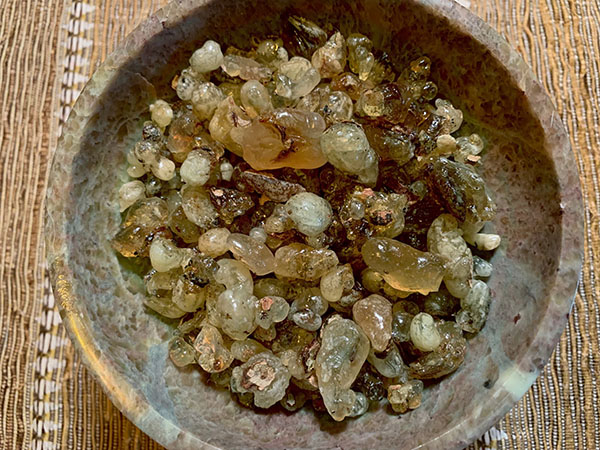
This is a Frankincense relatively new to the market, a must for collectors. The Hidden or Occult Frankincense was officially discovered in 2019 in the Ceel Ufeyn area of northern Somalia/Somaliland. Similar to Carterii, but with its own unique scent. The tears are varied in size and color.
"Boswellia occulta is a very different tree than its neighbours the B. carterii trees. Historically, Boswellia Occulta resin has always been mixed in with the local Frankincense Carterii and considered by locals to be the same tree. The name "Occulta comes from the Latin, Occultus which means "Hidden. Though this species has been present as long as any other Frankincense species and is an important commercial crop locally, it remained hidden from the view of botanists till recently. Hence the name-Occulta.
Not only do its simple leaves look different than most other Frankincense species, but Frankincense Occulta oleoresin has a chemical composition that is very different from that of all other known Frankincense species."
Thanks to Dan of Apothecary's Garden and JK of Rising Phoenix
For More on Occulta Frankincense:
https://journals.sagepub.com/doi/pdf/10.1177/1934578X19866307
Be-en-Foret, Esprit de la Nature:
A little digging revealed that Boswellia occulta is quite new to Western awareness. For ages, this African resin stayed close to home, used by locals or sent across the Gulf of Aden to Arabia. But starting around 2015, the war in Yemen, which is located on the other side of the Gulf from Somalia, closed traditional trading routes to the Arab States. The resin, and its particular chemical makeup known as methoxyalkanes, started appearing as a fragrant abnormality in the quality testing for essential oil distillations. Methoxyalkanes and their unique aroma profile appear very rarely in nature. So far, they have been found only in the silk of golden orb spiders where the chemicals provide flexibility and resistance to environmental factors and in millipedes as a kind of “raincoat” to protect them insects against environmental moisture and desiccation. It is likely that B. occulta trees also evolved producing methoxyalkanes against environmental stresses. The abnormality of methoxyalkanes in the quality control reports set universities, research groups, and essential-oil companies searching for the source of the trees. They were led to a cluster of trees that grow only in a small area of Somaliland at a lower altitude than other Frankincense trees. In observing the trees in situ, the researchers also discovered that the B. occulta trees are unmistakably different from the other frankincense trees of the region. B. occulta has smooth gray bark and hairless, simple leaves (one leaf per attachment) and, nothing like the shaggy bark and downy, compound leaves (many leaves creating a frond effect) of the more familiar B. carteri. According to the inter-generational knowledge of the local harvesters, these trees always produced a gum resin with a different scent compared to the others in the region. In light of B. occulta’s uniquely aromatic and psychoactive properties, it is understandable that its scarce resin was kept within local circles and seldom entered wider trade.