Muma Padurii - The Forest Mother
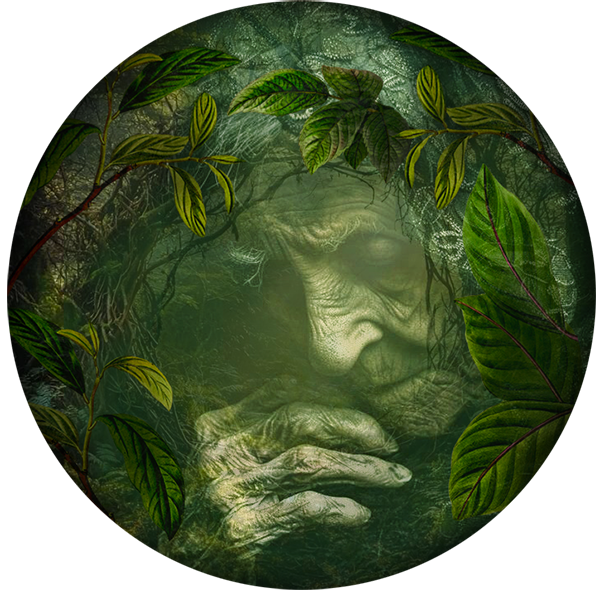

A walk in the deep forest at night guided by only fragments of starlight. Evoking a wildwood scent-scape with its dark-green smells of conifers mingled with the aromas of purple berries, mycelium, roots and slightly sweet, earthy crushed underfoot with a hint of smoke from a far away fire kept burning with aged oak wood. An incense to be used for the pure pleasure of it, when you want to connect to nature spirits or need support bridging troubled times
Ingredients: Bog Oakwood, Whiskey Oakwood, Resinated Spruce Bark, Agarwood, Birch Polypore Fungi, Tree Lichens, Spruce needles, Reindeer Lichen, White Cedar foliage, Balsam Fir Needles, Patchouli leaves, Spikenard root, Poplar Buds, Red Spruce resin, Labdanum resin, Neglecta frankincense, Black Mastic, Black Hemlock extract, Balsam Fir extract, Birch Tar extract bound with organic honey and raisins soaked in dark cherry wine. Packed with Amanita muscaria mushrooms, Birch Bark and Spruce needles
Being a deep forest-dweller myself, I’ve always been drawn to the female spirits of folklore who live in the woodlands. The women of the wild who are fierce, dangerous, and sometimes grotesque, yet who hold a hidden benevolence to help and the power to heal. The Russian Baba Yaga is the most well known of these figures. In the folklore of my Romanian ancestry, Muma Pădurii is one of the most ancient and evocative figures. Each region in Romania has their own stories about Muma Pădurii laid overlaid with thousands of years of meanings.
Her name means literally “Mother of the Forest”. Most regions have stories of Muma Pădurii as a goddess of the forest, mistress of everything that gives birth, grows and lives in the forest. Often described as an old, gnarled, and terrifying crone who lives deep in the woods, far from human dwellings, she can also appear as a beautiful maiden, a wind, a shadow, or an animal. She lives in the heart of the forest “untouched by the ax and untrampled by the foot of human beings”. Sometimes she is a sad mother who moans, mourns, sighs, snorts, wailing because people cut down her babies, the trees in the forest. She punishes robbers and helps troubled people-especially women, knows all her trees in the forest, calls them by name or nickname, but curses them to be cut down by man or lightning when they upset her. She punishes the loggers who disregard the rules of the forest, those who pick fruits and berries on certain days of the year when the wild animals would be entitled to them. In some parts of Banat and Transylvăania, she appears as a benevolent being, who shows children lost in the forest the way home.
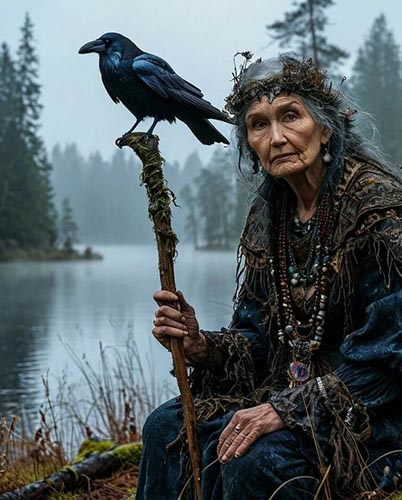
She often takes the form of an animal or a woman who resembles a stumpy tree with long tangled hair or braids that fall from her head to heels like snakes, dressed in tree moss.
Muma Pădurii is also an entity who embodies both the wild soul of nature and the dark feminine power that tests, teaches, and guards the thresholds of life and death. I believe that she is truly ancient. Not thousands of years old but tens of thousands of years old. Mumă in Romanian folklore often means “origin-being” or “personified force,” not simply “mother.” Muma Pădurii’s associations with snakes, bird, deer, bears, caves, springs and the night are markers of her truly ancient roots.
From the Romanian Poem
“Ballad of the Mountains”
The black deers shivered
Scared from a thicket
Ashy fawn came out to
The clearing
With its fur ruffled, it
Sits and listens motionlessly.
The weather seems frozen
The fir trees bowed their heads,
Frightened, as if in prayer:
There, deep at the end of the ravine,
Dozing on a stump,
The Muma of the Forest appeared.
But no one is there to see
Her gaunt and twisted body,
Her face yellow as tinder,
Her nose—a knot of dried fir wood.
She neither sees nor hears,
She only shakes, upon one hand,
Her hair of sodden twigs,
Her brow smeared with earth.
And as she sits with mist behind her,
Spent, beside the fallen trunk,
Roots and withered branches
Hang down from her knees.
The damp fog drains her strength;
Her unmoving, ashen eyes
Call the night and the silence
From the depths of the forest.
George Topârceanu first published in 1916
I too dwell in the wildwood at night. For many months of the year, I work in the forest every night. In woodland clearings, under the changing phases of the moon, I harvest and make extractions of night blooming flowers. Like a Neanderthal, I have always been able to see better than most people in the dark. So, journeying between the clearings, I turn off my flashlight. The forest becomes an embodied experience guided only by celestial light and my intuition. The sounds of wild hares alert me. The dark, earthy smells of the forest night winds contain messages. The movement of the moon marks the time. I have made peace with many fears in the dark.
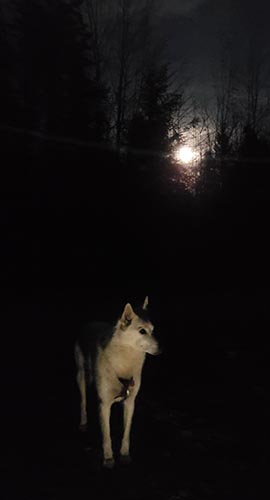
Muma Padurii Paleolithic/Neolithic Archetype
The region that is now Romania was inhabited by early humans, with evidence of human presence dating back to around 200,000 years ago. The earliest known Homo sapiens in Europe, discovered in the Peștera cu Oase ("Cave with Bones") are in southwestern Romania. Their bones date to approximately 34,950 years ago and show signs of interbreeding with Neanderthals. The mountains of the region contain a large number of caves, which attracted both human and cave bear residents. Muma Pădurii’s likely came into being more during this time when people were going into caves for shelter and ceremony. She was bear, snake and dripping waters.
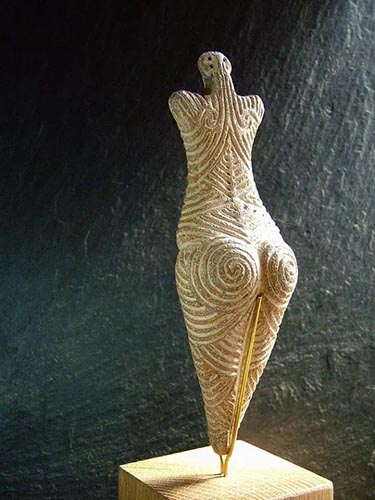
On bones, stones, antlers and goddess figures, our Palaeolithic ancestors used a system of lunar notation as early as 40,000 BC. In the waning moon, our ancestors would have mourned the retreat of life, the departure of the goddess; and in the darkness of the absent moon, they longed for her light to return. Over time, they must have learned to trust in the crescent’s reappearance, coming to see darkness as a season of waiting before new life emerges. In death, they felt themselves returned to the Mother’s dark womb, believing they, like the moon, would be reborn. Darkness was not opposed to light, nor death to life, but rather a facet of the Mother Goddess herself. The fourth, invisible phase of the moon was expressed as spirals, meanders, snakes and labyrinths. The Mother Goddess was a symbol of all the cycles of life. She was the transformer of the life she brought out of herself and took back into herself in a cycle of time as perpetual and enduring as that of the moon. Our ancestors lived fearlessly and harmoniously understanding the concept of constant rebirth and renewal in all things. That sometimes we have to go into the dark to be reborn.
As the glaciers retreated and climate warmed, birch spruce, pine, larch and other pioneer trees expanded first into the region. Then much of the lowlands and lower mountain slopes became closed temperate forest. Muma Pădurii became the gentrix of trees and the tree of life itself. According to legend, the first oak tree sprang from the wrath of Muma Pădurii. The hunter Gheorghe, disrespected Muma Pădurii and was changed into a “beautiful and towering oak.”
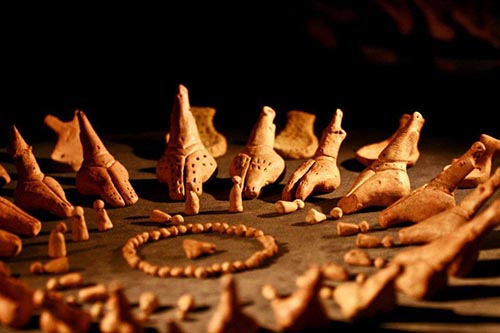
There is a clear history of Goddess worship in Romania during the Neolithic with female figurines abounding. The process of neolithisation, which is essentially a shift to plant growing and animal breeding, was the result of the immigration to Romania by communities carrying the southern, Neolithic, agricultural civilizations. The archaeological record shows some conflict but over all cooperation defines the era with gradual replacement of Mesolithic populations by Neolithic farmers over several centuries. Muma Pădurii would have been easily integrated into the spiritual life of a civilization that honored women and respected the cyclical nature of life, nature and its limits.
Around 3000 BCE, the Indo-European pastoralists came from the eastern Steppes, bringing sky-father gods, warrior myths, and sacrificial rites that clashed with the older, earth-centered traditions. It was then that Muma Pădurii first began to lose her ancient depth and turn dark in the minds of the people. Later, Greek and Roman patriarchal religions. Finally, Christianity, rising around 300 CE, pressed hard against the old feminine powers. The wild forest mother was reshaped into a monstrous she-demon. It is hard to kill the genuine spirit of the land even over thousands of years of repression. In pockets of remote regions, Muma Pădurii maintained her benevolent character and she is on the rise again today. Romania still contains some of Europe’s most valuable relatively intact forest ecosystems and large carnivore populations compared the rest of Europe Lately Muma Pădurii has been embraced as an ecological activist protecting forest ecosystems. Still living in the roots and soil of the land, she like many feminine land spirits, are rising with the moon, to bring renewal to the land.